nook
A nook for nuclear structure data: level schemes from ENSDF and RIPL-3, with the awkward parts — significant-digit uncertainties, spin-parity alternatives, widths masquerading as half-lives, Fortran fixed-format files — parsed into real objects instead of strings.
No required dependencies. pandas is optional, for .to_dataframe();
matplotlib is optional, for the figures.
import nook

scheme = nook.level_scheme("24Mg")          # adopted levels, via the IAEA API
for lv in scheme.below(10_000):
    print(lv.energy_kev, lv.spin_parity, lv.half_life.seconds.value)
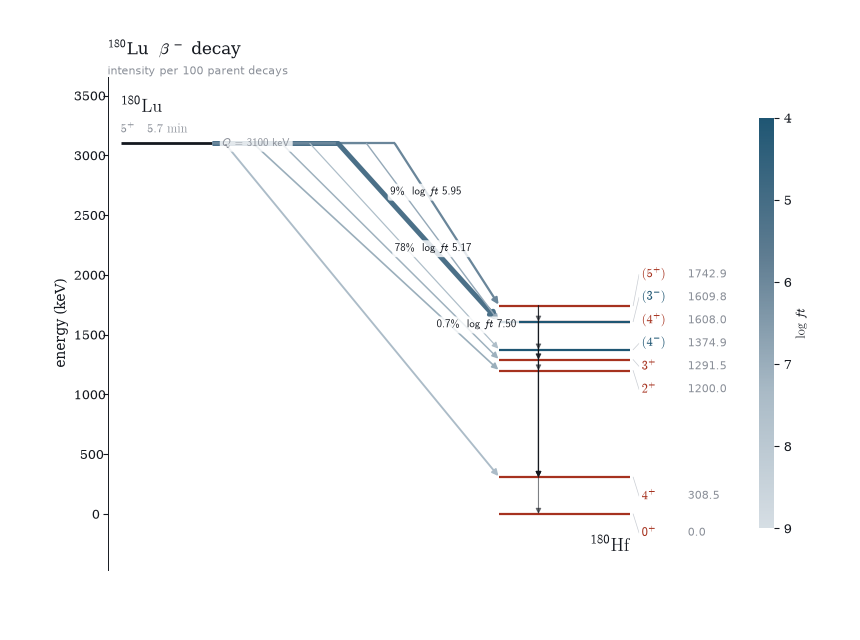
Three backends, one data model
|
|
|
|
|---|---|---|---|
Source |
IAEA Livechart API |
NNDC archival flat files |
RIPL-3 mirror on disk |
Coverage |
adopted levels only |
every evaluated dataset |
levels + reaction inputs |
Needs network |
yes (responses cached) |
no |
no |
Setup |
none |
download mass chains, set |
committed mirror, or |
All three return the same LevelScheme, so downstream code
doesn’t branch. For a specific evaluation rather than the adopted set:
scheme = nook.level_scheme("24Mg", source="file", dataset="(P,T)")
Flat files come from https://www.nndc.bnl.gov/ensdfarchivals/ — one per mass
number, ensdf.024. Extract them somewhere and export ENSDF_PATH.
RIPL-3 goes beyond levels: masses (experimental and theory), average resonance
parameters, giant dipole resonances and gamma strength, optical-model
potentials, level densities and fission barriers. Where sources overlap,
nook.compare matches them:
result = nook.compare.levels("24Mg", sources=("file", "ripl3"))
result.rms_delta_kev            # 1.5 keV over 72 matched levels
nook.compare.masses("180Ta")    # AME vs RIPL vs FRDM95 vs HFB-14
Install
pip install 'nook[plot]'
Extras: plot (matplotlib figures), pandas (.to_dataframe()),
uncertainties; dev pulls in all of them plus pytest. Or, working from a
checkout with uv:
uv sync --extra dev        # creates .venv with the package and dev extras
uv run pytest              # ~5 s against committed fixtures
uv run nook 24Mg           # the CLI
Reference
Development